Powerful Branding: From Identity to Impact
About This Talk
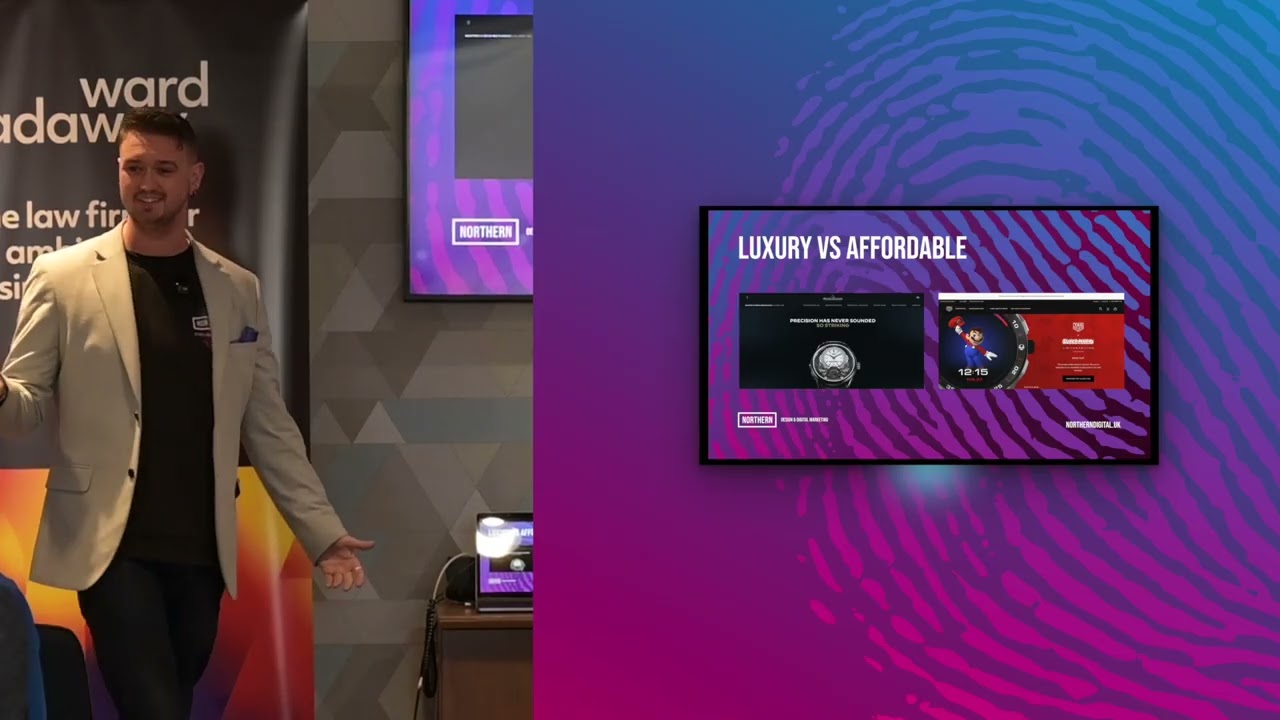
Dave talks about how brand is not just about colouring in — it’s about all the senses and other things that can impact your identity and online presence. From the pink prison effect to AI in marketing, this talk covers brand personality, colour psychology, and how to stand out.
Full Transcript
Next up, we like to have Dave. So, big round of applause to Dave. >> Thank you. Cheers. >> Thanks. Go that way. >> Hey everyone. So, I'm Dave from Northern Design and Digital Marketing. What I do is I specialize in coloring in to get you leads on your website or online or anywhere you want to do. But brand and what I'm going to talk about today is how brand is not just about coloring in and how it's all of these other senses and other things that can impact your identity and online presence. So, a little bit about me is I started my career as a very drunk 15-year-old pissed in the bar when I shouldn't have been knocked on a print shop and went, "Hi, everyone. Can I have a job, please?" Uh, and they went, "Hi." So, I started 15-year-old in a print shop working is touching paper, feeling paper, and now I know the stock levels and know grams per square inch by hand. I can feel a piece of paper and say, "That's 20 g per square in, that's 120, that's 300." It's a really great skill to have when designing and making print products. But moved in, moved around the world a little bit, went to Amsterdam, designed for Mario hotels and Citizen M hotels. Came back to the UK and designed for Porsche and for some social housing companies like Gen 2 and uh some of the other ones around the Northeast. It's been a great experience. But what I've learned is that brand isn't just colors and it's all of these different aspects of your life and different things that you get when you or things that you deal with or sense as well. So what I'll start with is the pink prison effect. Has anyone heard of the pink prison effect or not? It kind of goes on when you're talking about color as well earlier, but there we go. Which one of those rooms would you rather be in? you'd rather be on the one on the right because it feels more energized and it feels more energetic. The one on the left actually feels a bit dull, feels a little bit you don't really want to play your game. So, what was actually done is in prisons in around the late '7s, early 80s, there was some research done that painting the prisons pink actually reduced testosterone in people and reduced the aggression caused by the inmates. But that could be used in football. And this is where I first heard about this was when I went to Stadium Light when I was 10 years old and they paint the actual change rooms were painted pink to kind of get people to or get the opposition to not play as well. But that can like you say it can affect how you play and the color that you have in your brand can also affect that. Like purple is more luxury, the blue is more regal, but that also affects where you are in the world as well. We in the UK think green is eco eco-friendly. In America it's all money. So it's where we have blue for the business side, America has the uh the green for the money side of things in the business. And the same goes for red and China. It's all different of what you show, what your culture and what you what you associate with as well. But what I'm going to do is kind of get you to think about your business as a brand as well. So imagine you're at a cocktail party and your business is in the corner. Who is your business? Describe them. Are they wearing are they the suit in the corner or are they the clown that's getting drunk? Which are you the more fun? Like think of it like Apple is probably the more corporate guy with a turtleneck, obviously Steve Jobs, but then you've got Lush who's the little hippie in the corner. Which who are you and how would you define that? So which one of those are you? And this is why I love AI because AI generated this for me as well. >> That's me in the middle >> in the middle. I'd say the clown's more me. I'm a bit of a clown. >> I think he was on about the six pack more than >> But no, try and associate yourself with one of these. Are you the more corporate? Are you the more playful? Are you the clown? Are you the funny? Are you the or the rebel? And it's not just a logo as well. It's all about your senses. Like look at Barbie. Barbie's pink is branded. It's actually um what's the word where if you use that same pink, it's registered. It's a copyrighted color. You can't use their pink anywhere else. So Barbie, you know that when Mattel branded everywhere around the Northeast or even around the UK or around the world, you knew it was Barbie just by the pink straight away. and it was just easily recognizable. But then Netflix, you've got the tadum at the intro. It's that straight away you've got that introduction. Not only Netflix does it, you've got Google, YouTube, everywhere does it now. Anything other than video has a sonic identity. But a sonic identity isn't just the intro sounds. It's the music that you play at the hotels or that's around in the atmosphere. So when I worked at Citizen M hotels, we had a sonic identity for each time of day. 7:00 in the morning to about 11:00 it was like chilled relaxed vibes. About afternoon times it would get a bit more energetic indie style music and on a night it would be slow progressive house. This is actually influenced what you ate, how you ate and what you did in the hotel and how you interacted with other guests. The sub the house made you talk more and feel more relaxed because of the subbase. The indie kind of made you feel a bit hungry for some reason. I don't I haven't got the research to prove that but there was some research there. But a little bit of indie music in the afternoon makes you want to eat. Or then Apple, you've got smell. Everyone opened an apple box and then you get that apple smell or you walk through. That's called an effect of identity as well. Again, going back to Citizen M Hotels where I used to work is this is where I learned all of this about brand. We had a guy whose job title or his business was called the nose. He creates all of the scents and we would pump this scent through the hotel through the actual in the actual corridors as you walked in you knew instantly that you were there. And that's done in a few different places, different hotels or different like Lush for example or even what's the really dark shop called? Uh there we go. Hollister has their own scent as well. And you walk in Hollister and you know you're in Hollister. Not because you can't see anything, but because it smells. But it's all about all of these different things that affect the senses as well. And then Lush. Lush while obviously smell, but it's about the tactile. It's tactile branding. You go in, you feel the products. You feel how it works. You actually engage with it. And a lot of other brands do that as well. Apple does it with the boxes, the luxury style boxes and the uh the packaging. It's how you feel when you're using it. And then Nike is emotion. Emotion is a really powerful one when it comes to marketing as well. it instead of just saying I'm going to buy your shoes or buy our shoes. It's like the only limit is you. It's all about how you feel and that's how you appeal to your brand and that's who they're targeting their demographic perfectly because it's the emotion that they portray when they do that. It's often like the underdog stories as well that they do and it's all about storytelling. And then you've got tone of voice. Innocent do this really, really well. Their little playful brand. I love Monzo's tone of voice. Their brand guidelines are great. They're quirky. They're funny. They're in your face. But then you've got the corporate style as well. It's how you what words you use and how you write them down. Again, going back to my experience at Citizen M, we actually didn't capitalize the first line of every sentence because it would make it easier for people to read. There's so many different ways you can go in depth in brand. And it's not just your logo, it's not just your color, it's all of everything that you feel, everything you sense, even the way you look. I've even got my own branded pocket squares because it's all about what you do and how you feel comfortable in yourself as well. But what is branding and how do you do it? It's not just a logo, it's perception. It's how you feel. It's how other people It's what other people talk about you when you're not in the room. It's you as a brand, whether it's your personal brand, your business brand, and all of these different things. It's all of these signals that need to be consistent with who you are. And how do you define it as well? Like what does it mean? What do all these brands mean? These are the archetypes. So you've got the hero, you which is more like the Nike, the aspirational side. You've got the ruler, which is like Rolex, the regality, the this is who I am. I have some status. Or you've got the pur the purity from Dove, which is like we're innocent, we're happy, we're all about this. Or the sage, the educator, the TED talks platform will probably fall under the TED tide or the uh sage side, the educational. And it's all about that brand and how you associate yourself with that. So, I'm going to ask you, what archetype do you think this is? Do you think it's more the ruler, the rebel, the pictures? If you remember the ones at the beginning, do you remember one of those characters? Would it be any of those? Rebel? Absolutely. You got to bang on. But why? It's because it's bold. It's rebellious. It's fearless. It's rules are meant to be broken. And that's how these archetypes sit with your brand as well and how you can define them. And it attracts people who feel dissatisfied with the Fosters or with all of the other typical brands that have just Fosters Heinek. And they're all very similar in a way where Brew Dog came and disrupted the market with its own individuality, its rebel side, its punkness. And what I'm going to say is which one of these is luxury and which one is affordable? >> Why? Why do you think I >> think it's just because of the brand actual the actual watch is like a top watch, isn't it? >> Yeah. You feel you feel luxury straight away. But if you look a little bit deeper, it's got it's because of the fonts. It's because of the the sharp edges. It's the contrast, the high contrast ratio. If you look on the right, you've got playful fonts. You've got the Super Mario the cartoon style. You've got cartoons as well. And it's all of these different things that can define how you how you feel when interacting with this brand. And same with this one. Which one's masculine? Which one's feminine? And try to avoid the pink. Just ignore the pink for now. It kind of gives it away. But if you were avoid the pink, ignore the pink. Which one's masculine? Which one's feminine? >> That's all right. >> Yeah. Because of the harsh the very uh serap fonts, the very the black, the high contrast, the sharp edges. If you look at the one on the left, they've got rounded corners. Even just a rounded corner can actually make feels feel a little bit more relaxed and a little bit more gentle. And that's where the femininity comes from. So, how do you define your identity as well? How do you use this in your brand? And how can you like bring this for yourself? We've got this little slider here. This is a no affiliation. This is another agency that I'm promoting, which I probably shouldn't, but they do a really good slider where you can actually generate and it'll come up with the answers for you. But is your business more industrial or more natural? How do you feel about that? Are you playful, more serious? But it's not just about how you feel. It's about how your customers feel. So we ran this with when I worked at Gen 2, we ran it internally where they thought they were quite a playful company and they thought that they were seen as a friendly interactive brand. We ran it with the customers of Gen 2, social housing customers. Complete opposite. They thought they were serious. They were corporate. They were tedious. They it was like but for social housing for people who are paying rent who don't understand the complexity of it. It's understandable why they felt like that. So how do we make it easier to understand? And that's where we got this brand identity and changed the way we spoke. We changed the way we address people. We use government guidelines for accessibility so that anybody the average reading age is 10year-old. So we educ we rewrote everything so that a 10-year-old could understand it. And that's why this worked and this brand identity and this slider helped us create that identity for the clients and made it easier to understand. But I'm not just about design and I'm not just about marketing. We do a lot of AI situations and a little AI marketing here as well. So one of the things I'm not going to go fully into detail about all the AI marketing I do. I'm just going to show you a couple of live examples. And AI is so helpful but it's not it's taking over everything and we don't want it to do that. We want to take it back a little bit and use it where it can help us. For example, if you go networking, you can scan a business card and automatically interact and automatically integrate that with your CRM as well. So, if I scan your business card, you'll get an email from me in the next hour or something as well. But this is the favorite my favorite one that I've built. How do I get the live demo on? You just >> come over the slide >> and then hang. >> There we are. >> Yeah. So what I've done is one of my clients is an estate agent. He has to upload everything to right move on the market um zupler and his own website every single day whenever he gets a new property for example. So if I press refresh and I click import properties what we're doing now is all of these properties are getting automatically imported from right move. So there's a thousand properties. If I press refresh again, there's some more properties. All of these are just getting automatically populated, scraped from right move, and instantly put into his website. So, if you think about how much time you'll save in doing that, go back. So, these are all the examples that you can do. And where's the right banner up there? >> There we are. just looks better. >> But no, you think about how much time he's saving now. That's saving him roughly about four hours a week. And I've got a few clients. Red Sky, for example. Anyone knows Red Sky Foundation? Great charity. They do some amazing stuff on Instagram. They share it all the time. And they've got great interactions. We scrape their Instagram and we pull out that week's top three posts and then we automatically send it to all their clients and all their all the people subscribed. They're getting real content rewritten and re repurposed. Saves them so much time as well. So, they're getting more subscribers, more uh donations because of all this outbound awareness that they're getting from stuff that they've already done. They're just talking about what they've already published and how it works and how it saves them. And you can also use voice. If anyone came to my first platform when I spoke last this time last year, I generated my entire talk as a blog as it with images and with video post and posted it all across all social medias from this one talk. I'm not doing that today because I'm recording it on video. So, it's not going to happen. But there are so many ways you can do this and there's so many different things you can automate in your life. And these are the ones that I've got running live right now. Imagine if you're you use a project management tool whether it's QuickBooks or sorry not QuickBooks whether it's notion Trello whatever you use whenever I put my client into the completion file or completed done it integrates with my QuickBooks and sends them an invoice I don't do invoice follow-ups it integrates with my emails the Facebook leads so if you're running Facebook adverts we integrate that with Pipe Drive they go directly into Pipe Drive and then they automatically do the follow-ups and there's your CRM system automatically sorted So many ways we can do this. The estate agent one that I mentioned that saves him time. The stack event manager or the live content creation. Imagine if you're driving home one day and you've got an idea for a blog. Just speak it into your phone. It's on your blog in 5 seconds. It's on your socials in 5 seconds. That's how much time you can save. And it's not just about creating crap for the sake of it. It's saving you time and making things easier for you and letting AI do the grunt work, not reducing the creativity. Anyone got any questions? I know I went through that a little bit quick, so I was kind of putting a few things together. Any questions? >> Not so much a question, but I was in the section about Nike. >> Yeah. >> All my books. One of the best books I ever read over called um Shoe Dog by Phil Knight starting night. >> Mhm. >> If anyone's get inspiration brand when he was a student and where he all came from, Shoe Dog from Night is a fantastic book to read. >> Cool. >> Yeah. >> Just um a question about AI. Sure. >> Emails, >> of course. Go for it. >> So, what would your stance be? And you know, and I recognize that clients will have different feelings about this, but just thinking of the if you're with an email, this is a relationship between a person. >> Yeah. >> So, between you and another person and you were I think your example was with of charity. Yeah. and and so the the personal, >> you know, these are the great things we've done. And so you're you're trying to appeal to that person presumably to get that person to do things. >> Yeah. >> If a machine is generating emails, a person is not talking to a person. >> Yeah. >> And I, you know, I just think somewhere there needs to be an ethical discussion about that with businesses, with people, with because I absolutely understand the scaling and we've lived with for decades with form letters. >> So, we all get form letters, you know, through the post and now through email, but we know it's a form letter. We know that the person who signed the letter did not write that letter and is not writing to us and that this letter is is to six million people at the same time. It's not to us. But with AI now, you know, you can get emails, you can get the AI to generate an email that seems to be from you. >> And if the other person is not aware that a machine has written that, I think there's a rupture in our in in our personal communication. >> What does it matter that AI as long as the message is still correct? because we speak to each other >> and I would feel it it would bother me deeply if I replied to that thinking a person had written it when the person purporting to write it knows nothing about it doesn't care hasn't actually written that to me >> and I'm writing back and and I don't know that. And so I I think really my point is the declaration, this email has been generated by an AI so that you know that as the recipient and so you're not responding as though to a person. So that would and I I just think at the moment we're in this space where I go, oh yeah, it's going to save me hours and that's fantastic, >> but there is cost and I would just like us to think about the potential cost when we're making the decision about okay, I'm going to automate those emails and people will know this is not really when you get when you get an when you get a reminder about an invoice. How far do you go with this though? >> But if you get an email which is much more >> No, it's all right. >> Sorry, but if you get if you get an email which is much more personal >> like Paul, it would bother me deeply >> if I thought if I got an email from you and I thought it was from you >> and I replied >> in the in the mindset of like, oh, that is lovely. Paul's written me this lovely email. I'm going to take my time and answer him in a personal way. And I >> You were copyrighted by any chance? I would feel >> dis if it wasn't. >> So I don't do that. So interestingly yesterday, was it yesterday? I emailed someone. So So I send out email newsletters. I presume some of you read them, some of you don't. You said probably too many emails, right? >> But I can see who clicks on links or who opens them, right? So, I I put a link about the master class and and I could see who'd clicked on that link and someone who I know needs help with the sales and marketing clicked on it. So, I emailed that person directly. I said, "Oh, hi. I saw that you clicked on the link. Is it something you want to do?" Your reply was 10 out of 10 for the automated response. Uh it's I am interested, but I don't want to do it right now. And I reply was like it wasn't an auto it was mean like it was interest how he thought that that was >> that was automated and I think that's a rupture in between our personal communication with each other. I think we use that at our peril. >> I agree also a place for it though as so time efficiency which is what Dave getting to really use AI quite a lot for email newsletters but it doesn't go out automatically. >> So it generates my content of the newsletter which I then doctor >> Yeah. So it gives me maybe 80% of the ideas and stuff like that. It doesn't necessarily when you send out the language. You're not purporting to send out something personal >> to somebody. So there's an honesty about that. So I'm not saying >> by all means stop. I'm just saying let's think a little bit about what communication between ourselves actually means >> and when we want to automate and when we want to be clear about about >> you're too basic. I do agree. I do agree with it mati obviously from the human first responsibly I pledge you know we've had them heard our colleagues speak a few times at these event what I really like about what David did >> so I do do a lot of marketing and social media but it's it's mostly me doing it manually right so that would save me a lot of time >> think about it as repurposing >> time >> so I'm already creating the content but if I can use some AI to to take what I've already done and repurpose it in it which is going to save some of Right. And the AI is not creating anything that I haven't already done. It's just >> No, but the point I'm making is that with emails, it's specifically with emails that go to a person and where that other person might think either, oh, this is automated, and you're like, no, no, I I was speaking to you. That that's a disconnection. >> I don't I don't want it. I don't do that. >> Yeah. But but I think that needs to be in our decision-m process. >> It's how you use it. It's what you do. and the message that you send. And it can actually sound like you as well if you wanted to. Like I say, mine's fed by my own brand guidelines, my own tone of voice, but everything's got an approval process in there. If you want to use it, you don't have to. You have you can use approval. But what it is is getting your message out there quicker. It's efficiency, not personality. So, if your message is different because of the AI, that's you for not reading it properly. It's saved you time, not personality. And that's the thing, and that's what this does. And it's all about reusing the content. Got Neil and we got >> gonna say Dave that was mega time. >> Yeah, of course. Absolutely. >> Thank you. >> Thank you. My my point of view is just uh I think it's about using it responsibly and we've seen this before. You know, history has a way of repeating itself and and the way we've seen this happen already is in social media space, you know, and I think it's all about recognizing you, your brand, and using it responsibly ultimately. And what's the discussion around like responsibility and you know definitive that so therefore people like you get me to do and I think that's what what's going on I think there's a danger here where AI you're talking to AI effectively we are circumventing the middle bit which is ultimately to me to make a decision in pursuit and I use AI by the way just so I'm clear in pursuit of efficiency where is all this time that we've saved as a result more so I think we get danger and I actually actively use um AI but I think there's a danger I think the market going to dictate that whether or not people like you and me go you know what this is AI I'm not interested I'm opting out of that and I'll delete and I think that that's but right now this is untested uncharted whilst it works great but I think you'll have a hockey curve where it'll drop off instantly and I think we're seeing that with LinkedIn you go on LinkedIn right now engagement engagement rage bait rage bait rage bait I'm done I'm out of LinkedIn as we that danger that we don't work let's go for it doesn't and I think that market already said that >> I also think you don't know you won't know what's AI if you look if you go through a declaration of independence nothing's written by AI corn AI detector is 100% AI So we know for a fact the I wasn't there then. So it's how you use it, what's used it for. I say writing personal emails, totally agree they need to be personal. But I can't spell how how far is the AI or what you use AI for that you need to qualify it for. Do you see AI spell check? Cuz that's AI. It's how do you use it and how far the level and what you dictate cuz I can't spell and I'm terrible with grammar. So I use Grammarly. Is Grammarly AI? And that's the thing. It's where is that level? I'm not getting it to write everything, but it's I'm giving it the message. I'm giving it the tone and it's doing it that way. >> One more question and we'll have a copy. >> Yeah. >> Thank you. That was brilliant. And it's really interesting this discussion that's going on. >> I think it's good that we're having these. >> Yeah. Really interesting. And obviously to your point, you can even if the email so I I sit really in the middle of this. I love using AI, >> but I'm the human behind the prompt in the first place. Yeah. >> So if I if my email that goes out right has been tweaked and made to sound more beautiful in a different way, I had to put in all the first original prompting. I'm a human doing it. So I don't it's still come from me. Even though you may receive an email that AI just reentenced it slightly. The original thought was from Sarah Mills. >> AI AI can't do anything without us doing something to start with. >> It's that old phrase about computers. There's no such thing as robot error or computer error. >> Email to you personally that really my thought was behind it and I dumped it into chat or wherever I'm putting it. And all it did is it just re I like the way that's rewarded. It's all Sarah Mills's thoughts and ideas. It's written in Sarah Mills style because it knows who Sarah Mills is. It knows my language, how I speak and therefore I genuinely believe it's come from me >> because if I just say write an email, it's going to go what do you want me to write about? And it's actually really good if you think about how many people dyslex dyslexic can't even say the word. So they're using AI to create something. So it's coming from you first then it's being put in then you take it and then tweak it based on you. >> Exactly. >> So I think that is how we use it without but still have a personalization to it too. So I well well it's really good. Just on that point I've been mentoring Virgin for dyslexia founders program and I have to say the AI side of that is immense. Yeah, it's I'm dyslexic, so that's one of the reasons why I use it as well. >> Doesn't take personality away. It just helps them >> there. I'm just I got a technical question aside. >> Go for it. >> Um, so are using agents for to build the workflows or are using standalone products for >> agents and standalone. So depending on what it is, I'll either write the connect to the API directly or if it or I'll use agents like make and integrate it that way depending on which ones they are and some of them have integrations directly built into the AI. So Claude I use integrate that with my notion and my Gmail directly. So it's all integrated >> and for the on the B2B side when you are obviously working with a company dashboard to >> yeah use the APIs on >> sometimes yes sometimes for the example of the good estate agents that's just run every day. So most of the time most of them are just run on a daily basis or on a trigger basis by what's been published but most we can do dashboards. We don't really do them that often. We're not they're not really needed for what we do unless on the reporting side of things which get which is what we use instead of using uh Google what's it called 360. No but uh >> no the uh the 360 reporting tool insights Google insights. It's where you it's like the advanced version of the analytics. I forgot the name off the top of my head but it's we don't use that anymore. We just integrate everything within AI and put it through a database and call that from either Google Drive or a CSV file. >> Awesome. Right. Big round of applause. >> Thank you. >> Thank you. We're going to continue this conversation and talk about wisdom in the world of marketing.
What's costing you growth?
Let's find out. For free.
Book a free 30-minute strategy audit with Dave. We'll look at your marketing, find what's not working, and tell you exactly where to focus. No waffle. Just a canny plan you can act on.
Request Your Free Audit
Takes 30 seconds. No jargon, just results.